Born in Dexter’s Gordon Hall in 1875, Katharine Dexter McCormick overcame social barriers to become a pioneer in women’s education and suffrage. Discover her early journey from privileged upbringing to MIT graduate and women’s rights advocate.
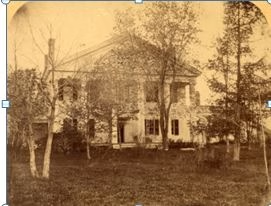
Editor’s Note: Katharine Dexter McCormick, the granddaughter of our founder Samuel Dexter, was born on August 27,1875 here in Dexter in Gordon Hall. During her life she made a significant impact on women’s equality in the areas of suffrage, birth control and education. To commemorate the life of one of our own on the 150th anniversary of her birth, the Dexter Area Historical Society has written a series of articles to share her amazing story with you.
This is the first article in the series, documenting her early life until her marriage to Stanley McCormick, an heir to the International Harvester fortune.
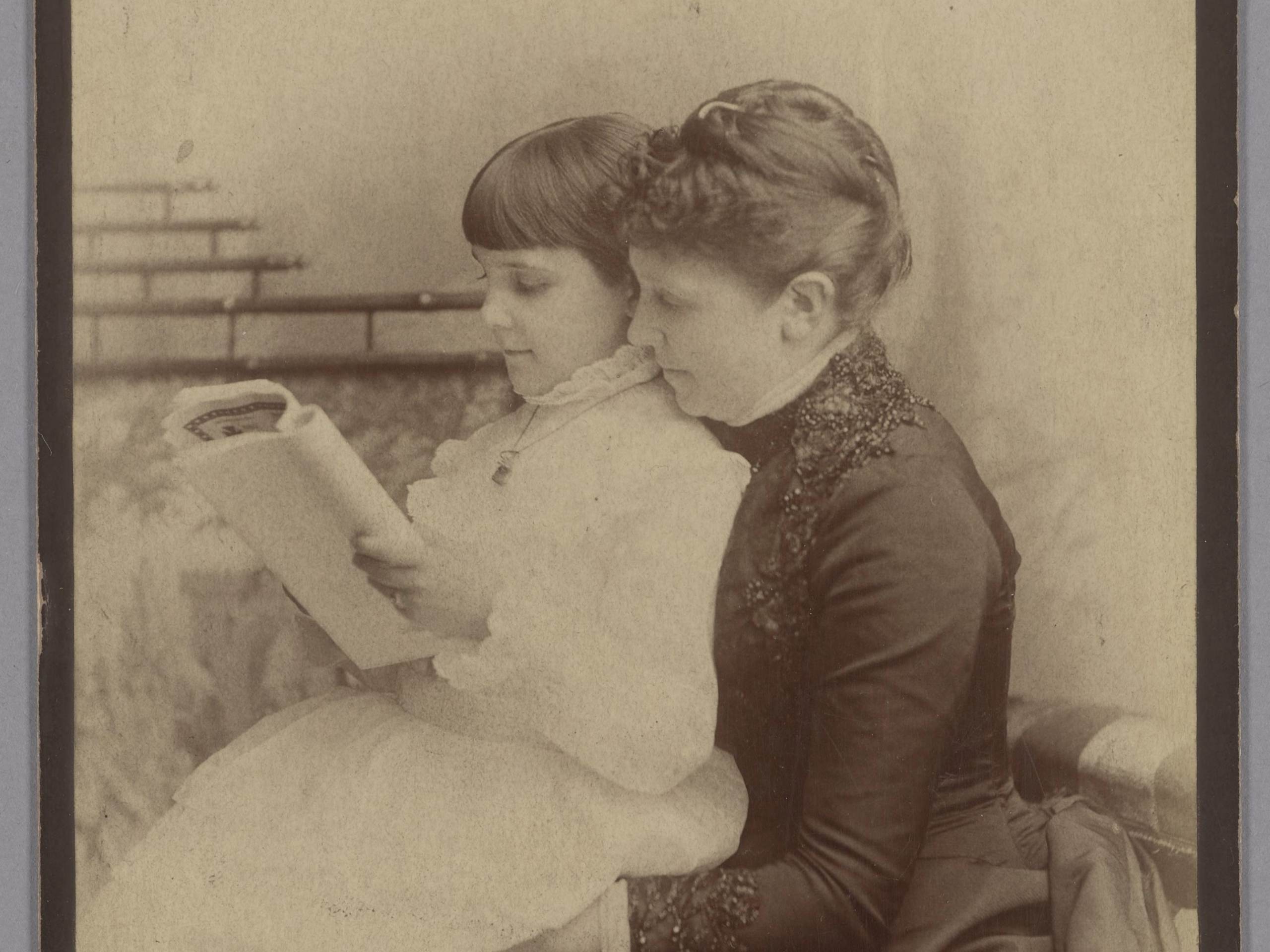
Katharine Moore Dexter, granddaughter of Judge Samuel Dexter, was born in Dexter’s Gordon Hall on August 27, 1875. Her family lived in Chicago, where her father, Wirt, was a prominent lawyer. In the summer of 1875, her mother, Josephine Moore Dexter, traveled to Dexter to await the birth. Wirt had just finished a case in Chicago and was about to start a high-profile case in Detroit. In August, Wirt took a break from work and was fishing in Michigan’s Upper Peninsula when his daughter was born. He passed through Dexter in early September to see his family on his way to Detroit, as noted in the Dexter Leader.
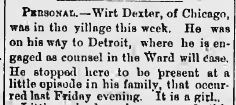
Wirt Dexter was well-known and well-liked. After the Chicago fire in 1871, he oversaw the relief effort. He was instrumental in many important cases of the time, and he was particularly noted for his oratory skills. In the Detroit case, Wirt represented the second wife of E.B. Ward, a wealthy Michigan businessman, whose will was being contested by the children of his first wife. In November of 1875, Wirt delivered the closing argument, which was well publicized and thus well attended. Even Josephine was in Detroit to hear the oratory. The case ended with a hung jury and the family returned to Chicago.
Their Chicago home was on Prairie Avenue in a well-to-do neighborhood. The Dexter household was supplemented by three servants as well as a butler and coachman. Katharine loved learning and books, but unlike her father, she was shy and reserved. She was described by her teachers as serious, mature and a high achiever. Her parents valued education, and both Katharine and her older brother, Samuel, attended the best private schools. They were also exposed to the arts, and it was not unusual for artists to visit their home. Travel was also part of their education.
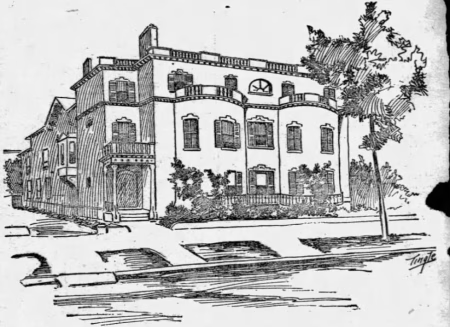
The Dexters participated in Chicago society, socializing with such families as the George Pullmans and Marshall Fields. As a young girl, Katharine was given dancing lessons, which is where she first met her future husband, Stanley McCormick. Katharine participated in society events and was given a coming-out party in 1895.
Katharine’s father, Wirt Dexter, died unexpectedly in 1890 when Katharine was 14 years old, just before a planned family trip to Dexter. Shortly after, she and her mother moved to Boston, where her brother Samuel, almost eight years her senior, was attending Harvard. Sadly, Samuel died of meningitis in 1893 at the age of 26. Katharine was very close to her brother and was devastated by his death. Katharine wrote to her grandmother Millicent Dexter of her sorrows. Samuel’s funeral was held at the Chicago Prairie Avenue home, which Josephine still owned.
Katharine planned to study science and even thought of becoming a doctor. However, after Samuel’s death, she felt she needed to accompany her grieving mother on a European trip, which lasted eighteen months, thus delaying her educational goals. During this trip, Josephine purchased a chateau near Geneva, Switzerland, which was where Katharine and Stanley McCormick were married. The chateau was later donated to the US State Department to be used by visiting dignitaries.
In November of 1895, they returned to Boston, and Katharine immediately enrolled in a local college. However, she determined that the science curriculum there was not robust enough to meet her goals. She was determined to enroll at the Massachusetts Institute of Technology, which was primarily a school for men – only one woman had ever graduated from the institution. She passed the entrance exams but was only admitted as a special student – not a degree candidate. To become a candidate for a degree, Katharine was required to complete several preparatory classes and pass a rigorous exam. It took three years, but at the age of 24, Katharine was admitted as a degree student in biology. She received her diploma in 1904, just a few months shy of her 29th birthday.
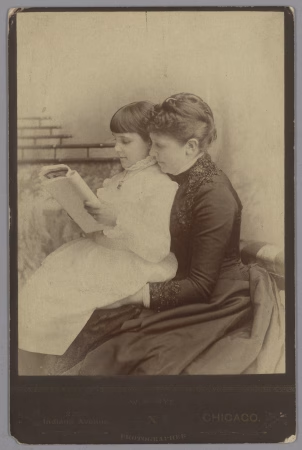
During this time, Katharine joined a group called the College Equal Suffrage League, whose objective was to promote the suffrage sentiment among college women. Katherine was drawn to this after the difficulties she endured in pursuing her advanced education at a male-dominated institution. This was the beginning of her long association with the fight for women’s rights.
While still in school in 1903, she was reintroduced to Stanley McCormick. Stanley was smitten with her, but his occasional erratic behavior concerned Katharine. In addition, his family, particularly his mother, objected to the match. Their tumultuous courtship finally culminated in their marriage at the chateau in Switzerland in September 1904. Their happiness did not last long as Stanley’s illness became more pronounced, resulting in hospitalization. In 1908, he was moved to the Riven Rock estate in California, where he remained for the rest of his life.
Editor’s note: In two, hear about Katharine McCormick’s work for women’s rights and health.





 8123 Main St Suite 200 Dexter, MI 48130